Posts

Showing posts with the label Astrolabe

On board the wonderful Australian icebreaker Aurora australis

Image
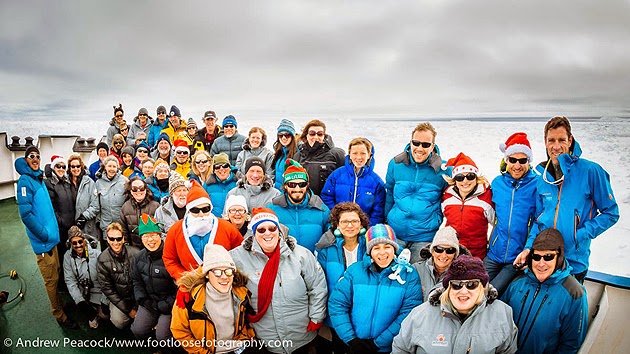
After the first decent night’s sleep in a fortnight, the team are starting to familarise themselves with their new home, on board the Australian icebreaker Aurora australis, a remarkable red giant that stands proud in the heavy pack ice. It has been an intense last 24 hours. Yesterday we woke to brilliant sunshine and calm on the Akademik Shokalskiy with no immediate news of evacuation. Indeed, we even had the Inaugural Mertz Writer’s Festival on the ice, in anticipation of another day locked in. But by 1800, we were in evacuation mode. The Russian crew opted to remain with their vessel until either conditions improve or they are broken out by another vessel capable of reaching them. Captain Igor and his crew were completely unflappable and provided a wonderfully calming influence for everyone else. By midnight we were all safely on board the Aurora thanks to some impressive helicopter sorties by the Chinese from their icebreaker Xue Long ( Snow Dragon ); round trips betwee...

One week on

Image
It has been a sobering week. At the time we were initially caught by the sea ice, the  Shokalskiy  was just 2 to 4 nautical miles from open water. Now the sea ice distance has become even greater with the continued winds from the east, putting our nearest point of exit at some 16 nautical miles. The international effort has been extraordinary and we are incredibly grateful for all the hard work and effort everyone has provided to assist the Australasian Antarctic Expedition 2013-14 in escaping from the ice – a big thanks in particular to the Chinese, French and Australians, co-ordinated by the Australian Maritime Rescue Centre. The winds have eased slightly but at times have reached in excess of 70 kilometres an hour – equivalent to the average conditions experienced by Sir Douglas Mawson’s original expedition a century ago at Cape Denison. It is humbling to consider these men not only survived but thrived, mounting a major scientific expedition. A continent of extremes was ...

The AAE has met heavy ice

Image
Following our successful visit to Cape Denison, sea ice remained clear, allowing our science expedition to proceed to the Mertz Glacier and open water polynya on the other side of Commonwealth Bay. Good conditions allowed the team to reach the Hodgeman Islets to continue our science programme and make comparisons to our findings around Mawson’s Hut. We managed to collect a range of samples for three of the science teams on these rarely visited islands; a fantastic result. The distance from the land to the sea ice edge is only 5 kilometres, providing an excellent test of the impact of the large sea ice extent around Cape Denison. Supported by volunteers on board, our teams investigated marine mammals, ornithology, glaciology while oceanographic work continued on board. Kerry-Jayne Wilson of the Blue Penguin Trust found the penguin colony on the Hodgeman Islets is thriving, demonstrating the distance the Mawson Hut Adelie penguins have to travel is a major factor in the fall of numbers...