Posts

Showing posts with the label floes

Return to Mawson's Hut...one hundred years on

Image
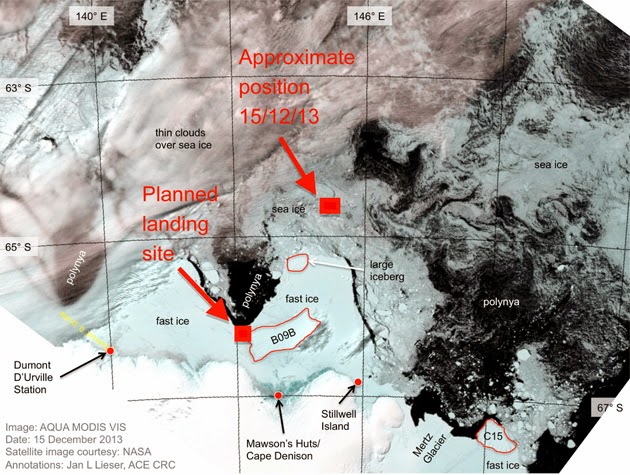
We’ve had an exhilarating couple of days and I’m just taking stock of all that has taken place. The last time I wrote was in the early hours of the 19th making final preparations for our attempt to reach Cape Denison. During the previous day, we had arrived in Commonwealth Bay and secured the  Shokalskiy  against the sea ice edge, some 65 kilometres from our goal. Over the next 12 hours, two reconnaissance trips were made using an eclectic choice of transport: quad bikes, all terrain vehicles and skis. The plan was to find a route over the ice towards Cape Denison while the science team continued their work around the ship. Unfortunately both recce teams returned with tales of a chaotically jumbled surface. The wheeled vehicles struggled in the ice and the prospect of finding a route through to Cape Denison did not look good. But one of the real finds of this expedition has been the ATVs we call Argos. Looking like a tank, these eight-wheeled boats on wheels are the ultimate ...

Exploring the sea ice edge

Image
Adelie penguins watching our arrival Apologies for the short blog entry. The last 24 hours have been frantically busy. We have managed to get the team on the ice and started work exploring our environment and making scientific observations. Tracey has led her team to collect biopsy samples of Weddell Seas to get a better handle on diet for comparison to material collected a century ago while Erik has been leading the charge collecting ocean data off and on the sea ice edge. I hosted a Hangout on Air with Kerry-Jayne and had an fun conversation with Adelie penguins and a lone emperor penguin… and than half way through the broadcast an Orca turned up, breaking the surface, hissing as it went! This was all caught live and broadcast to the world. Must be a first!  The Hangout is now online  on the Chris Turney-Intrepid Science YouTube Channel. But the big update is Chris has led two recces to find a route to Cape Denison and returned with the news the ice is badly ...

We've reached Antarctica!

Image
After a fraught morning ploughing our way through the sea ice, the Shokalskiy finally broke into a huge area of open water. The contrast couldn’t have been more different. Over the past few days we have become surprisingly comfortable with crashing and shaking our way through sea ice. Now there is only the gentle throb of the ship’s engine. Captain Davis, Mawson’s second-in-command and future best man, was palpably relieved when he saw a similar sight to us in his first final approach to Commonwealth Bay: ‘We coasted along this barrier [the Mertz Glacier] up to its western end, and were then delighted to see open water extending away to the Southward inside a small fringe of pack; also a fine water sky to the southward.’ It’s reassuring to know we are travelling the same path as the original AAE. Working our way through the sea ice At first glance, the presence of open water in these latitudes does seem rather odd. Why is the area not covered with sea ice all the way to the co...

Southward ho!

Image
It is a fascinating experience going through the same decision making process as the expedition of 100 years ago. What Mawson’s captain Davis achieved with so little is extraordinary. Using just observations from their vessel the Aurora , the original AAE explored thousands of kilometres of ocean, much of it by working their way through the pack, probing for gaps and hoping they did not close up behind them. It takes incredible courage to do this. One mistake and the ship could be trapped in the ice – with no one in the outside world really knowing where they were. It’s hard to imagine this scenario today. We have all the advantages of modern technology. Daily satellite reports provide images of what lies ahead, the Australian Antarctic Division are kindly sending us daily weather reports for the region from Casey station (thanks Jane!) our location is publicly available, and if we get into serious trouble we can pick up the phone for help (albeit a last resort). That’s not to say we...

Going with the floe

Image
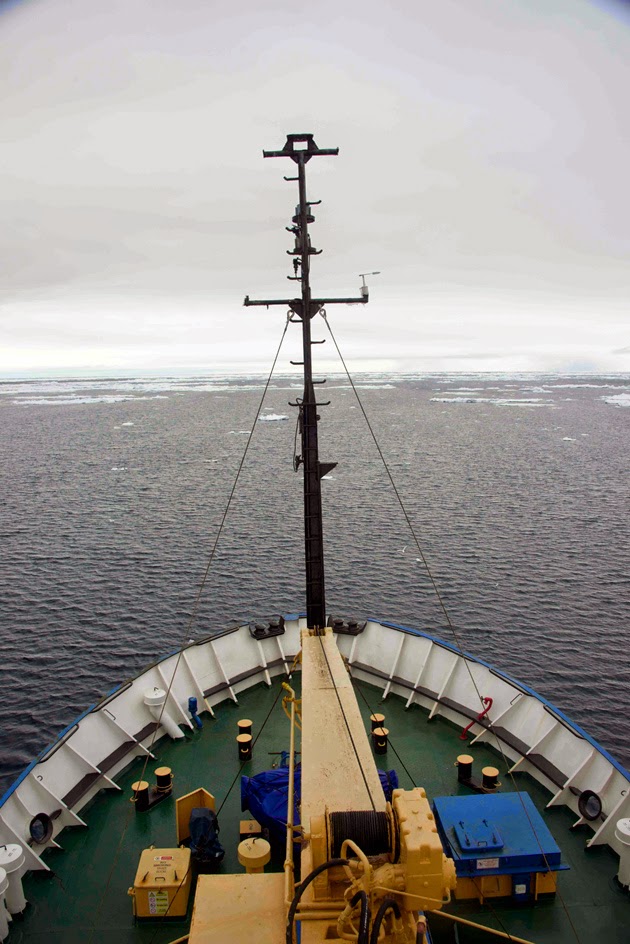
Punching your way through sea ice is a bit like being in a bombardment. One moment all is calm, the next silence is shattered by a crushing, grinding sound which reverberates throughout the ship. The duration of this assault on the senses can be fleeting or sustained, depending on the ice being negotiated by the vessel. The Shokalskiy is fortunately an ice-strengthened vessel but that doesn’t mean it is invincible. The ship’s captain Igor and his team have to carefully select which ice floes they negotiate while keeping an eye on what lies beyond. The rule of thumb is that only some 10-20% of ice can be seen floating above the surface. So 40 cm of visible ice means at least 160 cm is submerged. An important statistic when you’re taking an unsupported vessel deep into the pack ice, hundreds of kilometres from the nearest living soul. Approaching sea ice Today had everything with dizzying highs and lows. We woke to fog but this cleared early morning to leave us with a brilliant ...