Posts

Showing posts with the label Mertz Glacier

Ice cold in Commonwealth Bay

Image
Commonwealth Bay in the East Antarctic will be forever associated with Sir Douglas Mawson’s pioneering scientific venture a century ago: the Australasian Antarctic Expedition. Mawson’s team had only intended to spend one year south, but it was not to be. A sudden turn of events led to tragedy on the ice, the deaths of two men, allegations of cannibalism and, with the return of winter sea ice, an extended stay in Antarctica. While the efforts of Mawson and his men laid the foundations for modern Antarctic science, the region has continued to experience dramatic change. And it doesn’t get any more dramatic than the arrival of iceberg B09B in 2011. The word ‘berg’ doesn’t really do it justice though – B09B is a monster. Weighing in at an estimated 500 billion tonnes, this block of ice is 97 miles long and over 20 kilometres wide. There’s enough freshwater in B09B to provide all of New York’s drinking needs for 300 years. And it started out even larger. In 1987, an iceberg the size of B...

Leaving the Antarctic base Casey for Hobart: We are heading home!

Image
The last few days we have been staying on the icebreaker Aurora australis just off the the Antarctic coast near the Australian base of Casey. For the operations team on the vessel, it has been a busy time, resupplying the station, bringing gear and waste offshore, balancing logistical needs against the ever changing weather. For those on the AAE, it has been a time for rest, work and reflection. Everyone seems to have slept – a lot. Afternoon naps are a common occurrence, and during lectures, no matter how interesting the content, many team members – including myself – have been known to doze off. No one seems to get upset by this; it’s just seems to be the natural way of things. Sunset at Casey Alongside the daily programme of talks, the team have been working hard on the analysis of the scientific data we have collected. Erik and Chris have been working on the salinity and temperature analyses made during the voyage south and around Commonwealth Bay. Chris Fogwill has been dr...

On board the wonderful Australian icebreaker Aurora australis

Image
After the first decent night’s sleep in a fortnight, the team are starting to familarise themselves with their new home, on board the Australian icebreaker Aurora australis, a remarkable red giant that stands proud in the heavy pack ice. It has been an intense last 24 hours. Yesterday we woke to brilliant sunshine and calm on the Akademik Shokalskiy with no immediate news of evacuation. Indeed, we even had the Inaugural Mertz Writer’s Festival on the ice, in anticipation of another day locked in. But by 1800, we were in evacuation mode. The Russian crew opted to remain with their vessel until either conditions improve or they are broken out by another vessel capable of reaching them. Captain Igor and his crew were completely unflappable and provided a wonderfully calming influence for everyone else. By midnight we were all safely on board the Aurora thanks to some impressive helicopter sorties by the Chinese from their icebreaker Xue Long ( Snow Dragon ); round trips betwee...

One week on

Image
It has been a sobering week. At the time we were initially caught by the sea ice, the  Shokalskiy  was just 2 to 4 nautical miles from open water. Now the sea ice distance has become even greater with the continued winds from the east, putting our nearest point of exit at some 16 nautical miles. The international effort has been extraordinary and we are incredibly grateful for all the hard work and effort everyone has provided to assist the Australasian Antarctic Expedition 2013-14 in escaping from the ice – a big thanks in particular to the Chinese, French and Australians, co-ordinated by the Australian Maritime Rescue Centre. The winds have eased slightly but at times have reached in excess of 70 kilometres an hour – equivalent to the average conditions experienced by Sir Douglas Mawson’s original expedition a century ago at Cape Denison. It is humbling to consider these men not only survived but thrived, mounting a major scientific expedition. A continent of extremes was ...

The AAE has met heavy ice

Image
Following our successful visit to Cape Denison, sea ice remained clear, allowing our science expedition to proceed to the Mertz Glacier and open water polynya on the other side of Commonwealth Bay. Good conditions allowed the team to reach the Hodgeman Islets to continue our science programme and make comparisons to our findings around Mawson’s Hut. We managed to collect a range of samples for three of the science teams on these rarely visited islands; a fantastic result. The distance from the land to the sea ice edge is only 5 kilometres, providing an excellent test of the impact of the large sea ice extent around Cape Denison. Supported by volunteers on board, our teams investigated marine mammals, ornithology, glaciology while oceanographic work continued on board. Kerry-Jayne Wilson of the Blue Penguin Trust found the penguin colony on the Hodgeman Islets is thriving, demonstrating the distance the Mawson Hut Adelie penguins have to travel is a major factor in the fall of numbers...

Return to Mawson's Hut...one hundred years on

Image
We’ve had an exhilarating couple of days and I’m just taking stock of all that has taken place. The last time I wrote was in the early hours of the 19th making final preparations for our attempt to reach Cape Denison. During the previous day, we had arrived in Commonwealth Bay and secured the  Shokalskiy  against the sea ice edge, some 65 kilometres from our goal. Over the next 12 hours, two reconnaissance trips were made using an eclectic choice of transport: quad bikes, all terrain vehicles and skis. The plan was to find a route over the ice towards Cape Denison while the science team continued their work around the ship. Unfortunately both recce teams returned with tales of a chaotically jumbled surface. The wheeled vehicles struggled in the ice and the prospect of finding a route through to Cape Denison did not look good. But one of the real finds of this expedition has been the ATVs we call Argos. Looking like a tank, these eight-wheeled boats on wheels are the ultimate ...

Exploring the sea ice edge

Image
Adelie penguins watching our arrival Apologies for the short blog entry. The last 24 hours have been frantically busy. We have managed to get the team on the ice and started work exploring our environment and making scientific observations. Tracey has led her team to collect biopsy samples of Weddell Seas to get a better handle on diet for comparison to material collected a century ago while Erik has been leading the charge collecting ocean data off and on the sea ice edge. I hosted a Hangout on Air with Kerry-Jayne and had an fun conversation with Adelie penguins and a lone emperor penguin… and than half way through the broadcast an Orca turned up, breaking the surface, hissing as it went! This was all caught live and broadcast to the world. Must be a first!  The Hangout is now online  on the Chris Turney-Intrepid Science YouTube Channel. But the big update is Chris has led two recces to find a route to Cape Denison and returned with the news the ice is badly ...

We've reached Antarctica!

Image
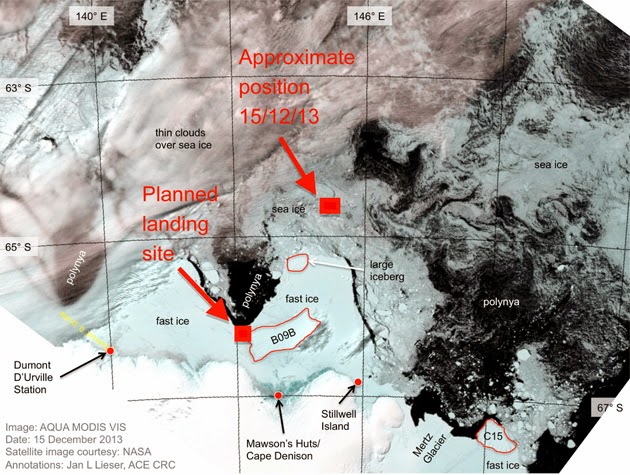
After a fraught morning ploughing our way through the sea ice, the Shokalskiy finally broke into a huge area of open water. The contrast couldn’t have been more different. Over the past few days we have become surprisingly comfortable with crashing and shaking our way through sea ice. Now there is only the gentle throb of the ship’s engine. Captain Davis, Mawson’s second-in-command and future best man, was palpably relieved when he saw a similar sight to us in his first final approach to Commonwealth Bay: ‘We coasted along this barrier [the Mertz Glacier] up to its western end, and were then delighted to see open water extending away to the Southward inside a small fringe of pack; also a fine water sky to the southward.’ It’s reassuring to know we are travelling the same path as the original AAE. Working our way through the sea ice At first glance, the presence of open water in these latitudes does seem rather odd. Why is the area not covered with sea ice all the way to the co...

Southward ho!

Image
It is a fascinating experience going through the same decision making process as the expedition of 100 years ago. What Mawson’s captain Davis achieved with so little is extraordinary. Using just observations from their vessel the Aurora , the original AAE explored thousands of kilometres of ocean, much of it by working their way through the pack, probing for gaps and hoping they did not close up behind them. It takes incredible courage to do this. One mistake and the ship could be trapped in the ice – with no one in the outside world really knowing where they were. It’s hard to imagine this scenario today. We have all the advantages of modern technology. Daily satellite reports provide images of what lies ahead, the Australian Antarctic Division are kindly sending us daily weather reports for the region from Casey station (thanks Jane!) our location is publicly available, and if we get into serious trouble we can pick up the phone for help (albeit a last resort). That’s not to say we...