Posts

Showing posts with the label spirit of mawson

The Tropics and the Furious Fifties

Image
There’s an old sailor’s expression: “Below 40 degrees south there is no law, below 50 degrees south there is no God.” Since the sixteenth century, sailors have spoken in awe of the violent westerly winds and seas they experienced fighting their way across the Southern Ocean. With few landmasses to slow them down, the winds found across 40 degrees latitude often reach speeds of twenty-five knots—about 40 percent stronger than their northern hemisphere counterparts—earning them the title the “roaring forties.” As shipping pushed farther south, explorers realized that these winds form part of a vast storm belt that includes the “furious fifties” and “screaming sixties,” names more reminiscent of terrible rock bands than a major part of our planet’s circulation system. The early hunters and traders didn’t understand it at the time, but these winds are created by a procession of low-pressure systems carried east by the jet stream, a river of cold air hurtling and twisting round the Antarct...

Ice cold in Commonwealth Bay

Image
Commonwealth Bay in the East Antarctic will be forever associated with Sir Douglas Mawson’s pioneering scientific venture a century ago: the Australasian Antarctic Expedition. Mawson’s team had only intended to spend one year south, but it was not to be. A sudden turn of events led to tragedy on the ice, the deaths of two men, allegations of cannibalism and, with the return of winter sea ice, an extended stay in Antarctica. While the efforts of Mawson and his men laid the foundations for modern Antarctic science, the region has continued to experience dramatic change. And it doesn’t get any more dramatic than the arrival of iceberg B09B in 2011. The word ‘berg’ doesn’t really do it justice though – B09B is a monster. Weighing in at an estimated 500 billion tonnes, this block of ice is 97 miles long and over 20 kilometres wide. There’s enough freshwater in B09B to provide all of New York’s drinking needs for 300 years. And it started out even larger. In 1987, an iceberg the size of B...

Return to the Home of the Blizzard

Image
In January 1910, the great scientist and explorer Douglas Mawson wrote in his diary ‘ Arrival in London. Interview with Captain Scott. He is surprised I am not just coming to enlist with him. I ask him has he thought of the coast W. of C. Adare. He said that he had not. ’ As an Antarctic veteran only 27 years of age, Mawson was dubious of the scientific value of reaching the Pole . Turning the British leader Scott down, Mawson was determined to explore the region south of Australia. There were so many questions, so little data. Most atlases had the bottom third of the Southern Hemisphere as a blank, white space, with ‘ Unexplored ’ stamped all over it. But the explorers, scientists and cartographers of the early twentieth century did not battle sub-zero temperatures and ice-scarred landscapes just to conquer land, bag a pole or grow an impressive beard. These expeditionary teams — even those intent on scoring a geographical first — went south to scientifically explore a new conti...

Leaving the Antarctic base Casey for Hobart: We are heading home!

Image
The last few days we have been staying on the icebreaker Aurora australis just off the the Antarctic coast near the Australian base of Casey. For the operations team on the vessel, it has been a busy time, resupplying the station, bringing gear and waste offshore, balancing logistical needs against the ever changing weather. For those on the AAE, it has been a time for rest, work and reflection. Everyone seems to have slept – a lot. Afternoon naps are a common occurrence, and during lectures, no matter how interesting the content, many team members – including myself – have been known to doze off. No one seems to get upset by this; it’s just seems to be the natural way of things. Sunset at Casey Alongside the daily programme of talks, the team have been working hard on the analysis of the scientific data we have collected. Erik and Chris have been working on the salinity and temperature analyses made during the voyage south and around Commonwealth Bay. Chris Fogwill has been dr...

On board the wonderful Australian icebreaker Aurora australis

Image
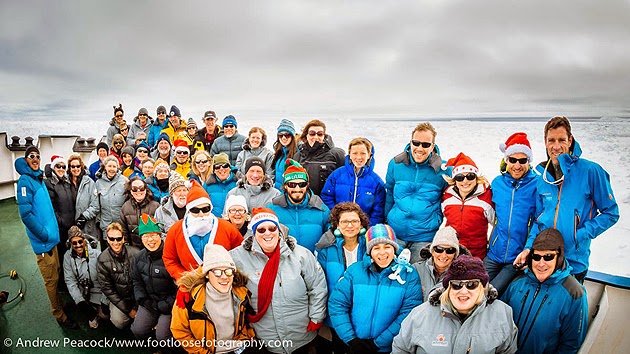
After the first decent night’s sleep in a fortnight, the team are starting to familarise themselves with their new home, on board the Australian icebreaker Aurora australis, a remarkable red giant that stands proud in the heavy pack ice. It has been an intense last 24 hours. Yesterday we woke to brilliant sunshine and calm on the Akademik Shokalskiy with no immediate news of evacuation. Indeed, we even had the Inaugural Mertz Writer’s Festival on the ice, in anticipation of another day locked in. But by 1800, we were in evacuation mode. The Russian crew opted to remain with their vessel until either conditions improve or they are broken out by another vessel capable of reaching them. Captain Igor and his crew were completely unflappable and provided a wonderfully calming influence for everyone else. By midnight we were all safely on board the Aurora thanks to some impressive helicopter sorties by the Chinese from their icebreaker Xue Long ( Snow Dragon ); round trips betwee...

One week on

Image
It has been a sobering week. At the time we were initially caught by the sea ice, the  Shokalskiy  was just 2 to 4 nautical miles from open water. Now the sea ice distance has become even greater with the continued winds from the east, putting our nearest point of exit at some 16 nautical miles. The international effort has been extraordinary and we are incredibly grateful for all the hard work and effort everyone has provided to assist the Australasian Antarctic Expedition 2013-14 in escaping from the ice – a big thanks in particular to the Chinese, French and Australians, co-ordinated by the Australian Maritime Rescue Centre. The winds have eased slightly but at times have reached in excess of 70 kilometres an hour – equivalent to the average conditions experienced by Sir Douglas Mawson’s original expedition a century ago at Cape Denison. It is humbling to consider these men not only survived but thrived, mounting a major scientific expedition. A continent of extremes was ...

The AAE has met heavy ice

Image
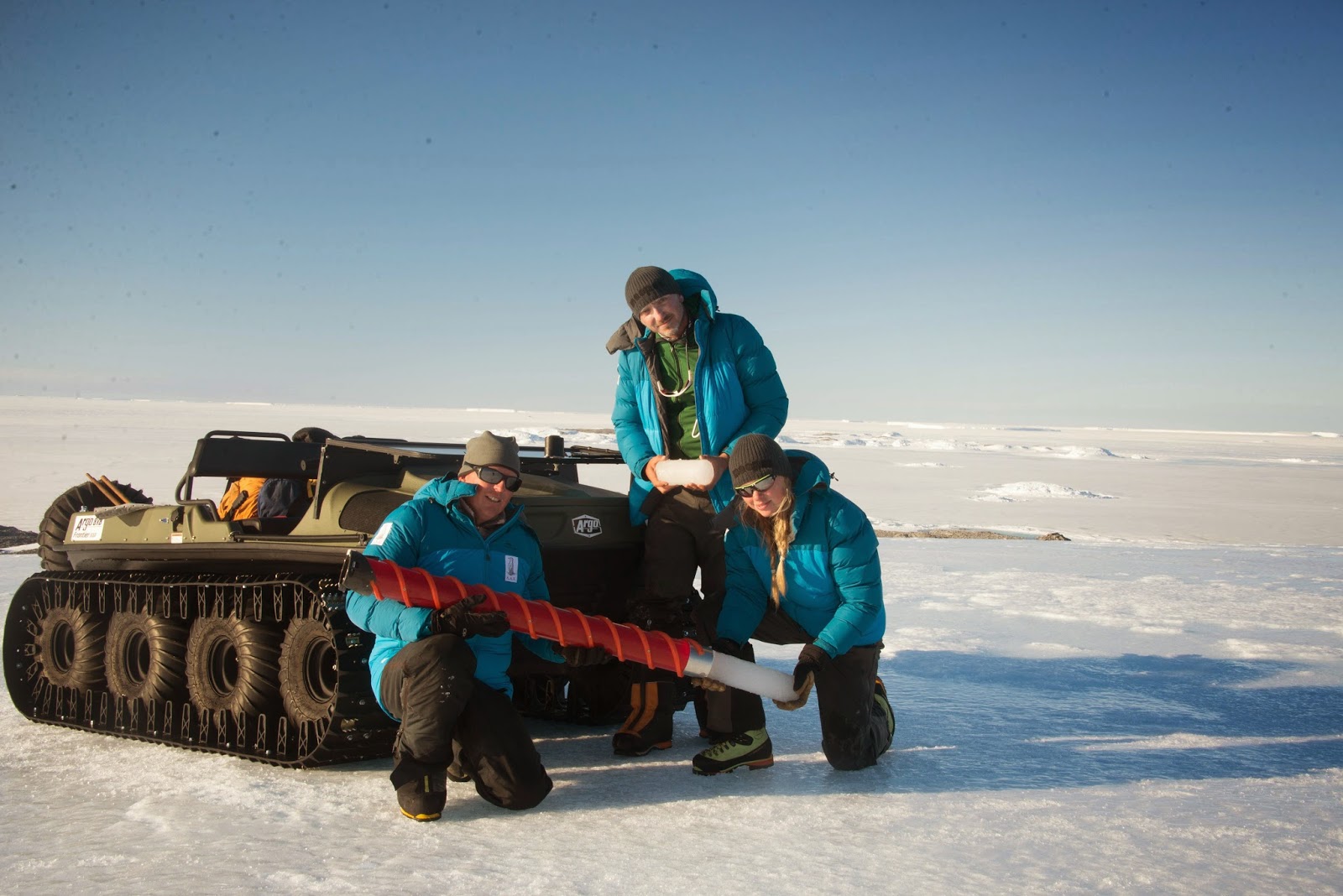
Following our successful visit to Cape Denison, sea ice remained clear, allowing our science expedition to proceed to the Mertz Glacier and open water polynya on the other side of Commonwealth Bay. Good conditions allowed the team to reach the Hodgeman Islets to continue our science programme and make comparisons to our findings around Mawson’s Hut. We managed to collect a range of samples for three of the science teams on these rarely visited islands; a fantastic result. The distance from the land to the sea ice edge is only 5 kilometres, providing an excellent test of the impact of the large sea ice extent around Cape Denison. Supported by volunteers on board, our teams investigated marine mammals, ornithology, glaciology while oceanographic work continued on board. Kerry-Jayne Wilson of the Blue Penguin Trust found the penguin colony on the Hodgeman Islets is thriving, demonstrating the distance the Mawson Hut Adelie penguins have to travel is a major factor in the fall of numbers...