Posts

Showing posts with the label aae

Anthropocene began in 1965, according to signs left in the world's 'loneliest tree'

Image
Anthropocene began in 1965, according to signs left in the world's 'loneliest tree' Pavla Fenwick , Author provided Chris Turney , UNSW ; Jonathan Palmer , UNSW , and Mark Maslin , UCL On Campbell Island in the Southern Ocean, some 400 miles south of New Zealand, is a single Sitka spruce. More than 170 miles from any other tree, it is often credited as the “world’s loneliest tree”. Planted in the early 20th century by Lord Ranfurly, governor of New Zealand, the tree’s wood has recorded the radiocarbon produced by above ground atomic bomb tests – and its annual layers show a peak in 1965, just after the tests were banned. The tree therefore gives us a potential marker for the start of the Anthropocene. But why 1965? The 1960s is a decade forever associated with the hippie movement and the birth of the modern environmentalism, a sun-blushed age in which the Apollo moon landings gave us the iconic image of a fragile planet fra...

The Tropics and the Furious Fifties

Image
There’s an old sailor’s expression: “Below 40 degrees south there is no law, below 50 degrees south there is no God.” Since the sixteenth century, sailors have spoken in awe of the violent westerly winds and seas they experienced fighting their way across the Southern Ocean. With few landmasses to slow them down, the winds found across 40 degrees latitude often reach speeds of twenty-five knots—about 40 percent stronger than their northern hemisphere counterparts—earning them the title the “roaring forties.” As shipping pushed farther south, explorers realized that these winds form part of a vast storm belt that includes the “furious fifties” and “screaming sixties,” names more reminiscent of terrible rock bands than a major part of our planet’s circulation system. The early hunters and traders didn’t understand it at the time, but these winds are created by a procession of low-pressure systems carried east by the jet stream, a river of cold air hurtling and twisting round the Antarct...

Ice cold in Commonwealth Bay

Image
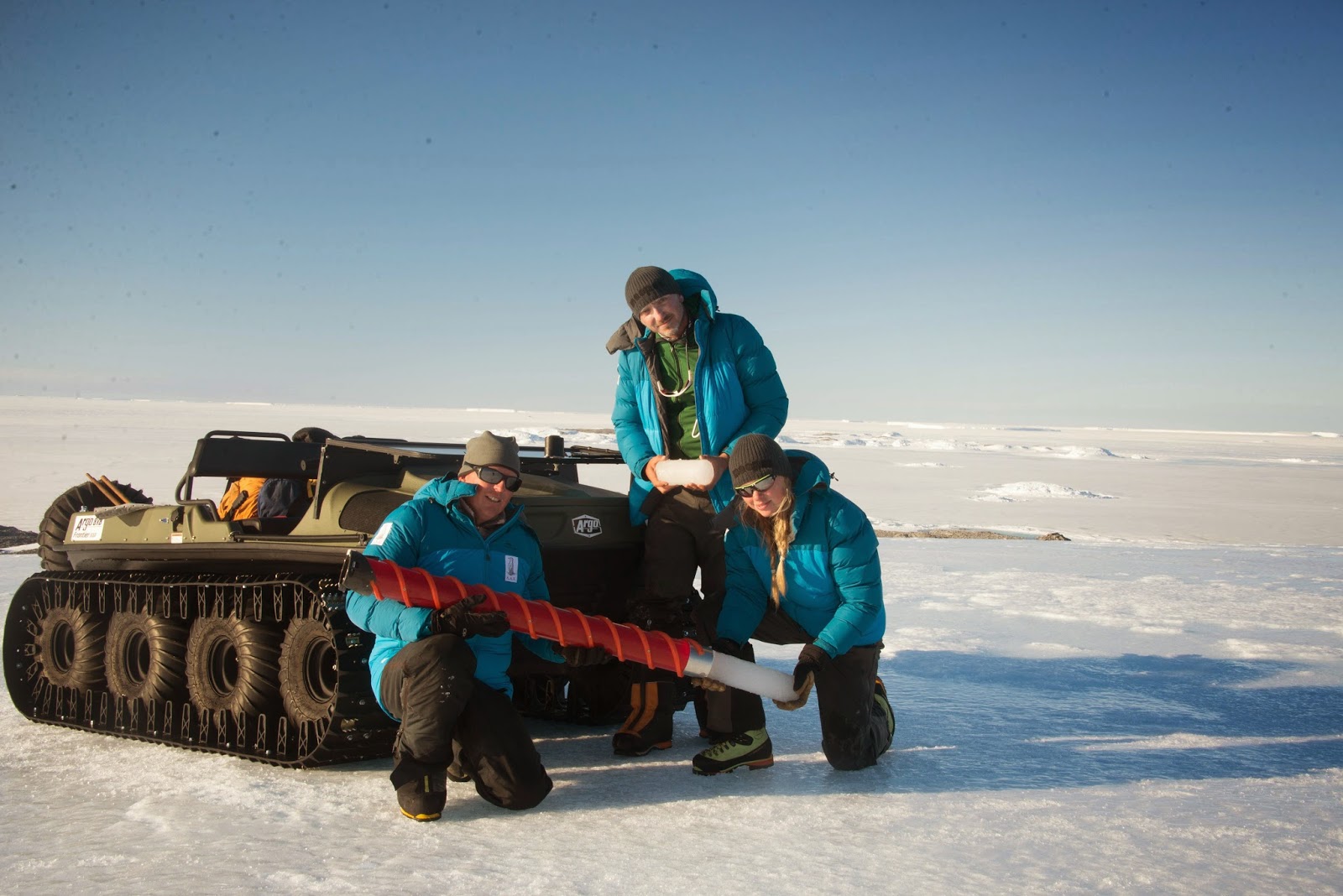
Commonwealth Bay in the East Antarctic will be forever associated with Sir Douglas Mawson’s pioneering scientific venture a century ago: the Australasian Antarctic Expedition. Mawson’s team had only intended to spend one year south, but it was not to be. A sudden turn of events led to tragedy on the ice, the deaths of two men, allegations of cannibalism and, with the return of winter sea ice, an extended stay in Antarctica. While the efforts of Mawson and his men laid the foundations for modern Antarctic science, the region has continued to experience dramatic change. And it doesn’t get any more dramatic than the arrival of iceberg B09B in 2011. The word ‘berg’ doesn’t really do it justice though – B09B is a monster. Weighing in at an estimated 500 billion tonnes, this block of ice is 97 miles long and over 20 kilometres wide. There’s enough freshwater in B09B to provide all of New York’s drinking needs for 300 years. And it started out even larger. In 1987, an iceberg the size of B...

Scientists need to engage more with the public to secure funding

Image
Scientists need to engage more with the public to secure funding Chris Turney , UNSW Australia and Christopher Fogwill , UNSW Australia We live in an age when society is crying out for scientific solutions to global problems. Just a few of the many considerable challenges we face include the urgent need to transition to a carbon-free economy, the need for new drugs to combat disease and improved agricultural yields to meet the needs of a growing world population. But in parallel to this increasing demand for science we face worrying trends in Australia and across the wider Western world. From high schools to universities, there is a long-term decline in students in the so-called STEM subjects (science, technology, engineering and mathematics). Meanwhile, government funding in many Western countries is also falling, with Australia continuing to reduce the total science budget . Repeated studies demonstrate public science investment has a strong multiplier effect on the econo...

Death of a colony

Image
Cape Denison holds a special place in the history of Antarctic exploration. A small outcrop of rocks on the remote East Antarctic coastline, Cape Denison is forever associated with one of the most spectacular and often forgotten tales of survival. A century ago it was the main base of operations for one of the great explorers of the south: the Australian scientist Sir Douglas Mawson . Privately funded, three bases and one research ship supported a science team that explored a region the size of the United States between 1911 and 1914. Mawson’s Australasian Antarctic Expedition, however, suffered terribly during their time at Cape Denison: a sudden turn of events led to tragedy on the ice, the death of two men, allegations of cannibalism and with the return of winter sea ice, an extended stay in Antarctica. But when they first came upon Cape Denison, Mawson was ecstatic. Greeted by squawking penguins: ‘ We were soon inside a beautiful, miniature harbour completely land-locked. The su...

Return to the Home of the Blizzard

Image
In January 1910, the great scientist and explorer Douglas Mawson wrote in his diary ‘ Arrival in London. Interview with Captain Scott. He is surprised I am not just coming to enlist with him. I ask him has he thought of the coast W. of C. Adare. He said that he had not. ’ As an Antarctic veteran only 27 years of age, Mawson was dubious of the scientific value of reaching the Pole . Turning the British leader Scott down, Mawson was determined to explore the region south of Australia. There were so many questions, so little data. Most atlases had the bottom third of the Southern Hemisphere as a blank, white space, with ‘ Unexplored ’ stamped all over it. But the explorers, scientists and cartographers of the early twentieth century did not battle sub-zero temperatures and ice-scarred landscapes just to conquer land, bag a pole or grow an impressive beard. These expeditionary teams — even those intent on scoring a geographical first — went south to scientifically explore a new conti...