Posts

Showing posts with the label University of New South Wales

Sydney declares a climate emergency – what does that mean in practice?

Sydney declares a climate emergency – what does that mean in practice? Chris Turney , UNSW Late on Monday night, the City of Sydney became the second state capital in Australia (after Hobart a week earlier ) to officially declare a climate emergency . With climate change considered a threat to human life, Sydney councillors unanimously supported a motion put forward by Lord Mayor Clover Moore to mobilise city resources to reduce carbon emissions and minimise the impact of future change. The decision sees Sydney join a variety of local and national governments around the world, in a movement that is increasingly gaining momentum . In total, some 658 local governments around the world have made the same declaration, with the UK and Canada committing their national governments to the global movement in just the past two months . An official declaration of climate emergency puts a government on a “wartime mobilisation” that places climate change at the centre of policy and plannin...

Anthropocene began in 1965, according to signs left in the world's 'loneliest tree'

Image
Anthropocene began in 1965, according to signs left in the world's 'loneliest tree' Pavla Fenwick , Author provided Chris Turney , UNSW ; Jonathan Palmer , UNSW , and Mark Maslin , UCL On Campbell Island in the Southern Ocean, some 400 miles south of New Zealand, is a single Sitka spruce. More than 170 miles from any other tree, it is often credited as the “world’s loneliest tree”. Planted in the early 20th century by Lord Ranfurly, governor of New Zealand, the tree’s wood has recorded the radiocarbon produced by above ground atomic bomb tests – and its annual layers show a peak in 1965, just after the tests were banned. The tree therefore gives us a potential marker for the start of the Anthropocene. But why 1965? The 1960s is a decade forever associated with the hippie movement and the birth of the modern environmentalism, a sun-blushed age in which the Apollo moon landings gave us the iconic image of a fragile planet fra...

Echoes of an ancient time in Australia

Image
Exciting results published today in the international science journal Nature provide precious new insights into the arrival and movement of humans across Australia over a staggering 50,000 years.  Sadly, many Aboriginal Australians no longer live where their ancestors had called home. So to better understand Australia’s history before the arrival of Europeans, a forward-thinking initiative called the Aboriginal Heritage Project was set up. Led by the University of Adelaide ’s Australian Centre for Ancient DNA (ACAD ) in partnership with the South Australian Museum and Aboriginal families and communities, the team – in which I was fortunate to play a small part – have uncovered some remarkable new findings.  Headed by Alan Cooper and Ray Tobler, the ACAD group analysed over 100 hair samples collected with consent from Aboriginal people across the continent between the 1920s and 1970s.  These samples were collected as part of a project where along with hair, det...

The New Zealand Subantarctic Islands Expedition of 2014

Image
Just a century ago a voyage to the subantarctic islands was a journey into the unknown. Tales of archipelagos home to thriving seal and penguin colonies and surrounded by vast numbers of whales promised riches to those who dared head south. But getting there was an entirely different matter. Ships literally sailed off the edge off the map in their quest for profit. The ‘Roaring Forties’ and ‘Furious Fifty’ winds made the Southern Ocean a dangerous place to venture in small wooden craft, while the islands were often poorly mapped or non-existent. Today the region offers wealth of a different sort to scientists. Yesterday, a team of five of us returned from a three week voyage to the Southern Ocean. Building on the scientific findings of the Australasian Antarctic Expedition 2013-2014 , we set out from the University of New South Wales to explore the changing climate and environment of the New Zealand subantarctic islands Campbell and Auckland. These biological hotspots straddle 50...

Final preparations

Image
I am sitting in Dubai, waiting to catch my flight back home. Looking out of the airport window, the sandy landscape blurs with the skyline, dissipated by the high temperatures outside. It’s the antithesis of where I’ll be in one week’s time. Instead of blistering heat, the Australasian Antarctic Expedition 2013-2014 will be departing from the Invercargill port of Bluff in southern New Zealand for the start of a six week voyage which we hope will culminate in reaching a frozen time capsule: Sir Douglas Mawson’s original expedition base at Commonwealth Bay, Antarctica . Two years of planning are finally coming to fruition. Two years of planning for a major science expedition; two years of putting together the best possible team and all the interviews, training, meetings, form filling, and equipment purchases and hire that go with it. Choices we made months ago are now committed. Only time will tell if we made the correct ones. To be honest, the last few months have been a bit of a...

We're off to the Antarctic Patriot Hills!

Image
Never has a continent been more misunderstood. Antarctica is on a scale hard to grasp: at over fourteen million square kilometres, it is second only to Russia in coverage of the Earth’s surface and bigger than all the countries of Europe combined. It is the world’s highest continent, with an average altitude of 2300 metres. It contains more than seventy per cent of the world’s freshwater, locked up as thirty million cubic kilometres of snow and ice—which, if it melted, would raise the planet’s seas by an estimated sixty-five metres, easily flooding the likes of Sydney, London and New York. The bitterly cold air on its upper surface contains virtually no moisture, making the Antarctic interior the world’s largest desert, while the rocks that make up the rest of the continent span almost the entire age of the Earth. The wildlife along its fringes is some of the most diverse on the planet. And yet the Antarctic remains one of the last great unexplored regions on our planet. In spit...

Quarrying the Antarctic for climate

Image
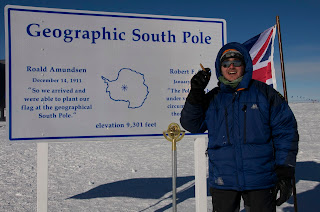
In 1773, Captain Cook described the great southern continent Terra Australis Incognita as ‘A country doomed by nature never once to feel the warmth of the sun’s rays but to lie forever buried under everlasting snow and ice’. But is it? We used to think of Antarctica being completely insulated from the rest of the world, effectively stuck in an ice age which most of the planet finished with 12,000 years ago. Disturbingly, there are signs that the image we’ve conjured up in our minds of a frozen continent is fast disappearing. Across this vast region, the last few decades has seen trends above and below the ice that are far from encouraging. Warming has been observed across large parts of the continent and it seems most probable its down to our high-energy lifestyles that has seen us flood the atmosphere with carbon . We even made it to the Pole for the centenary of Scott's arrival! Thanks to ALE. Unfortunately, Antarctica’s connection to the rest of the world means this sp...